
Suppose someone asks you today: Can you still make money from claw machines in 2026?
You might find it hard to answer right away. The easiest mistake people make in this business is assuming that it looks simple: the barrier to entry seems low, the machines themselves do not appear complicated, and there always seem to be people playing in malls, cinemas, and dining districts. But those who actually get into the business soon realize that a lively scene and a profitable business are never the same thing.
So rather than jumping to conclusions based on intuition, this article will walk you through the issue step by step and help you see clearly: is there still real opportunity in the claw machine market in 2026?
Chapter 1: The Reality of the Claw Machine Business in 2026
The claw machine market in 2026 can be summed up in three realities:
1) Trend: You can no longer rely on gut feeling—use Google Trends to see real demand
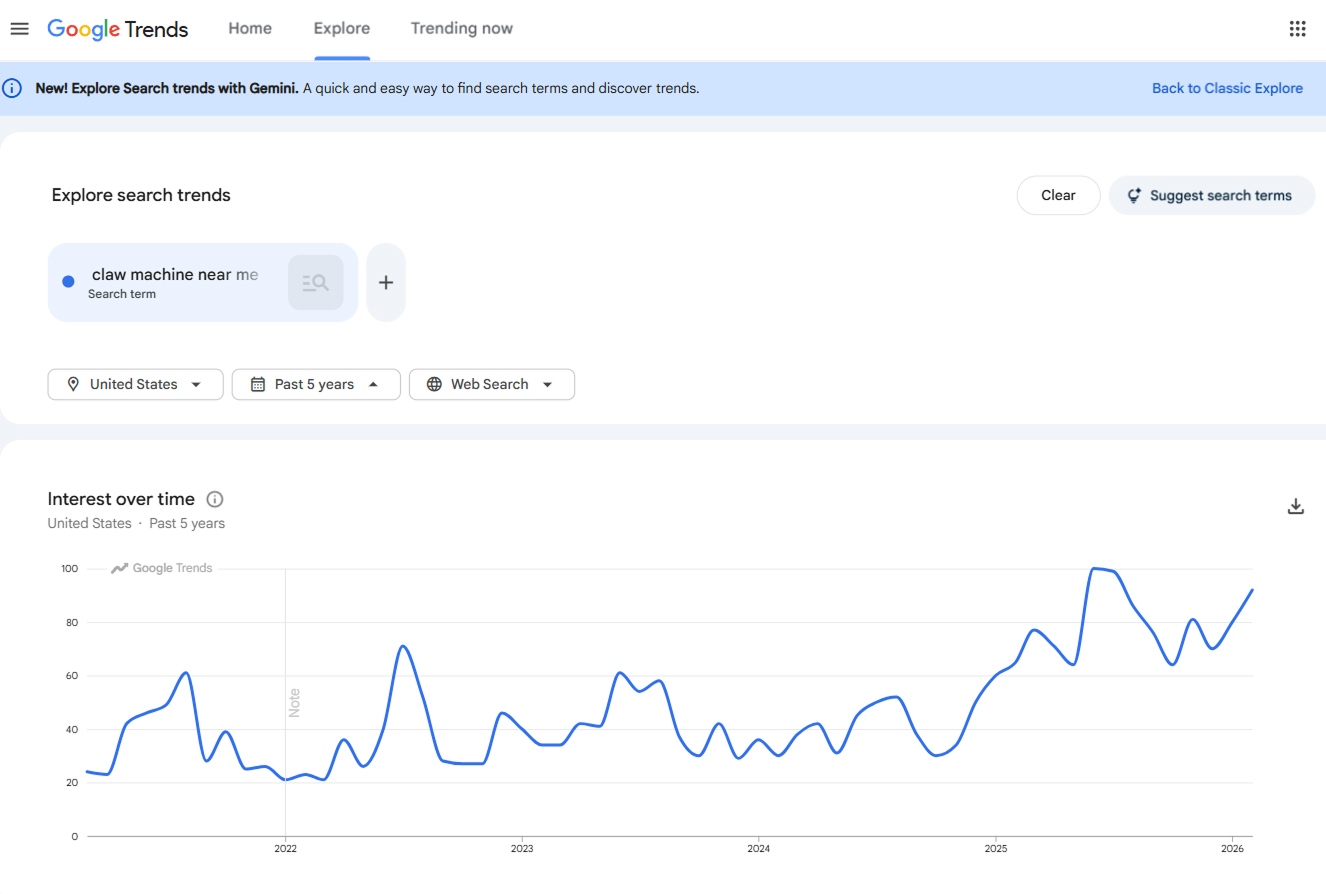
The simplest way is to open Google Trends, type in the keyword “claw machine near me,” and set the time range to the past five years. You will see a “trend curve.” The numbers are not exact search volumes; instead, they use a scale from 0 to 100 to represent relative interest: 100 means the peak popularity during that period, while 50 means the interest level was roughly half of the peak.
You do not need to obsess over the exact numbers. Just pay attention to two things:
Whether people are still searching for it consistently over the long term, which shows ongoing interest in finding a nearby place to play.
Whether the trend shows seasonal or cyclical patterns, such as stronger traffic on holidays or weekends, which suggests the activity is more of a casual add-on to shopping or hanging out.
2) Competition: Count competitors on the map, and you will know how crowded the market is
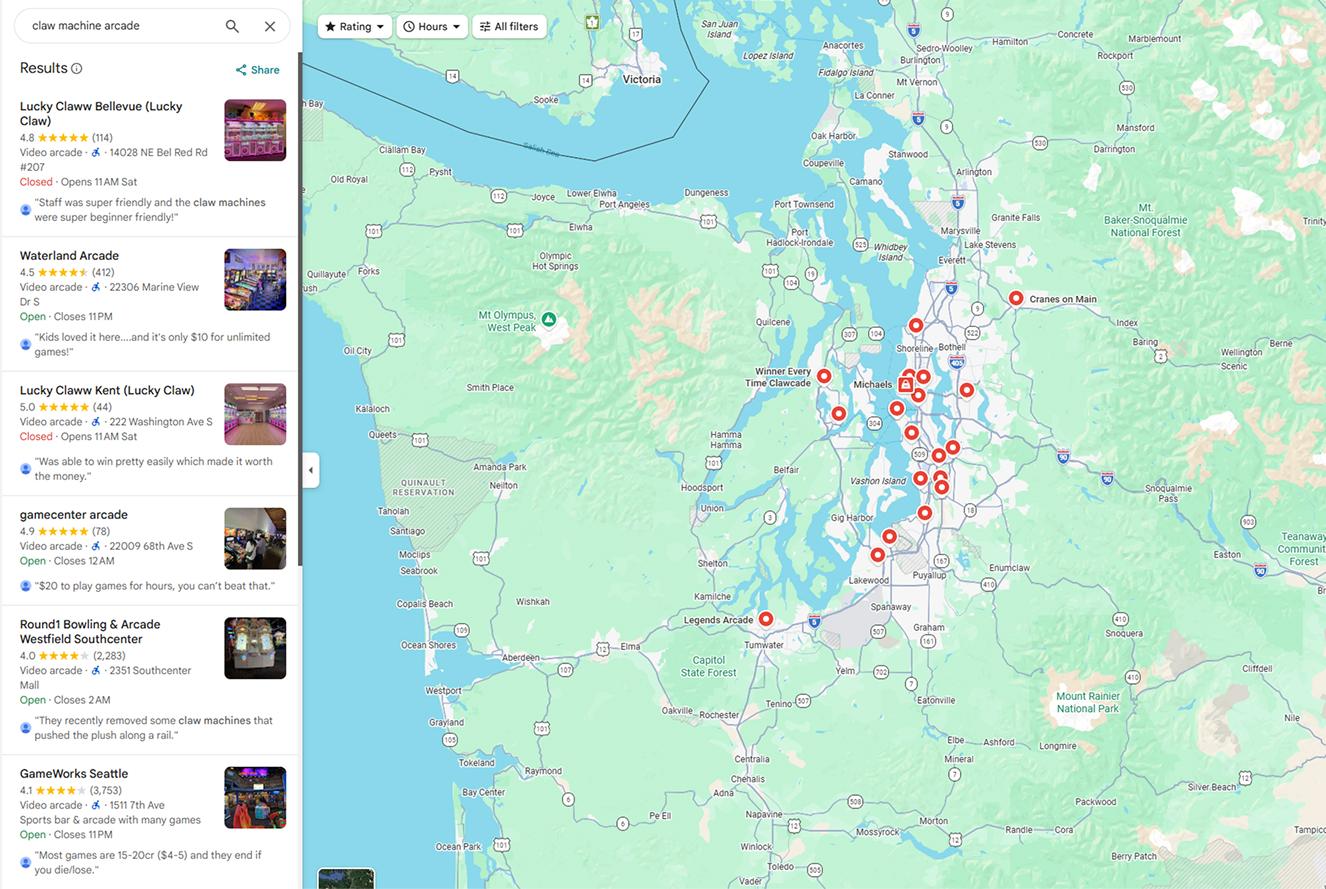
The second step is even more intuitive: open Google Maps (or Apple Maps, etc.) and search in your target city for:
“claw machine arcade / clawcade / arcade”
Then zoom the map down to the commercial district level—for example, within a 3–5 km radius around a mall—and look at the following:
How many venues are in the same area?
Are they concentrated near malls, cinemas, or restaurant districts?
If you find a dense cluster of locations in the same business zone, that means the business is not impossible—but winning will depend on better locations, better prizes, and more reliable maintenance. On the other hand, if some high-traffic areas are still relatively empty, that could be an opportunity.
3) Consumers: It is not just children—people aged 18–35 are one of the core groups willing to play repeatedly

Many people assume claw machines are mainly for kids, but in recent years the trend has looked more like an adult comeback. On one hand, there is nostalgia; on the other, there is the thrill of winning something and posting it on social media. Media coverage of claw arcades in different places has also noted that both children and adults often play together, and some people even come specifically to collect plush toys tied to popular IPs.
For operators, this directly affects how you choose prizes:
Children tend to prefer items that are cute, soft, and easy to carry around.
The 18–35 demographic responds more strongly to popular IPs, limited-edition appeal, collectible sets, and items that look good in photos.
In one sentence:
Claw machines in 2026 are not a “dead business.” Instead, they are a business where you need to use data to choose locations, maps to assess competition, and audience profiles to select prizes. If you run these three checks first, your odds of success will already be much higher than simply buying machines based on instinct.
Chapter 2: The Profit Model Behind a Claw Machine Business
Many people calculate claw machine profits by looking only at how much coin revenue came in today. But what really determines whether you can make money over the long term is very simple:
Revenue − (site fee + electricity + prizes + maintenance) = actual profit you take home.
A typical play often costs $1–$2, while site fees (whether fixed rent or revenue share) can easily consume 10%–30% of revenue. Add monthly maintenance and restocking costs, and what remains is your true profit.
To make this easier to understand, here are three typical scenarios. You can also treat these numbers as a rough calculator template and replace them with figures from your own city and target location.
Why can profit vary so much across three different scenarios?
Scenario A: Low-traffic convenience store
Revenue: $500
Costs: $400
(Rent $200 + Electricity $50 + Prizes $150)Profit: $100
The defining feature of this kind of location is that some people will casually play once or twice, but few will keep playing repeatedly. Your job here is to control prize costs and avoid wiping out your margin by using overly expensive prizes right from the start.
Scenario B: Medium-traffic cinema
Revenue: $2,000
Costs: $1,100
(Rent $600 + Electricity $100 + Prizes $400)Profit: $900
The biggest advantage of cinemas is the waiting period—before the movie starts or after it ends—when people are more willing to stop and play. Your focus should be to make the machine visible, tempting to try, and realistically winnable.
Scenario C: High-traffic tourist or entertainment spot
Revenue: $5,000
Costs: $2,500
(Rent $1,500 + Electricity $200 + Prizes $800)Profit: $2,500
These locations have a much higher profit ceiling, but site negotiation and machine performance become even more important because the venue owner is usually in a stronger bargaining position. If you make more, they will also want a larger share.
Three variables that determine whether a claw machine business makes money
1) Prize cost: More expensive is not always better—the key is “people want to play, and you still make money”
Many machines balance cost through settings such as win probability or difficulty level. A commonly mentioned win-rate range is 10%–30%. The essence is simple: players should not feel that winning is impossible, but you also should not be giving away prizes too easily.
A more practical approach is:
Tiered prizes: some items should look valuable to attract attention, while others should be more cost-friendly to preserve margin.
Bulk purchasing / negotiating discounts: the more consistent your monthly restocking, the more willing suppliers are to offer better prices.
2) How should you negotiate rent: fixed rent vs. revenue share?
You will usually encounter two models:
Fixed rent: you pay the venue a fixed amount every month (for example, $200 / $600 / $1,500).
Advantage: once the machine performs well, you keep more profit.
Disadvantage: you still carry the burden during slow seasons.
Revenue share: the venue takes a percentage of monthly sales. Many references use 10%–30% of revenue as a common benchmark.
Advantage: lower pressure; you are less likely to suffer badly during off-seasons.
Disadvantage: during busy seasons, the more you earn, the more you give up.
A simple way to choose:
If you are not yet confident in the location and are testing the waters for the first time, revenue sharing is usually safer.
If you are confident that traffic is strong and machine performance is stable, fixed rent offers a higher ceiling.
3) Electricity and maintenance: They look small, but they slowly eat into your profits
Many people overlook maintenance and the downtime caused by minor malfunctions. Maintenance is often estimated at tens to a couple hundred dollars per month.
Think of it as a basic operating rule:
the moment the machine stops, revenue drops to zero—but rent still has to be paid.
Conclusion of this chapter:
A claw machine business is not some mysterious art. It is a straightforward math problem. If you clearly calculate revenue, site fee, prize cost, and maintenance, then decide on your location, prize mix, and rental model accordingly, you can avoid most beginner mistakes.
Chapter 3: How Success Strategies for Claw Machines Have Evolved in 2026—It Is No Longer Just About “Good Location”
Many beginners think claw machine profitability simply means putting a machine in a place with a lot of foot traffic. But in 2026, what really creates a gap between winners and losers is something else: can you capture that brief moment when someone is willing to stop, and then make them want to play more than once?
1) Location Selection 4.0: Do not chase the most people—chase the people who are willing to stop

“Busy” does not necessarily mean “likely to play.” The most valuable traffic is the kind where people are already waiting, standing around, or casually checking their phones. Let’s call this high-intent dwell traffic:
In front of coffee shops or pick-up counters: while waiting for coffee or an order number to be called, people are especially likely to think, “Why not try one round?”
In line at trendy milk tea shops: the longer the line, the greater the demand for a small distraction.
Near ice cream or dessert windows: families and couples are more likely to play on impulse.
Near cinema exits or arcade exits: emotions are already elevated, and people still have loose change or a phone in hand, making conversion easier.
In the same mall, a machine placed in the middle of a hallway may simply be passed by, while one placed next to a queue is much more likely to stop people and get them to spend.
2) Modern solutions: Make payment smoother and reduce “I want to play, but it feels inconvenient”

One of the biggest reasons claw machines used to lose potential customers was not lack of interest, but inconvenience: no cash, no coins, nowhere to exchange money, too much trouble.
That is why in 2026, more locations are shifting toward cashless / mobile payment methods—card tap, phone tap, QR code, and so on. The goal is simple: turn “I want to play” into “I’m playing right now.”
A practical way to think about it:
In places with long queues and fast turnover, tap-to-pay (such as NFC, Apple Pay, or Google Pay) is better, because a single tap is usually faster than opening the camera, scanning a code, and completing the payment flow. Stripe has also noted that in high-traffic environments, NFC often provides a smoother experience, while recommending that businesses offer both options when possible.
In small shops, temporary locations, or lower-budget setups, QR payments have a lower entry barrier and can be implemented with a simple printed sign, though speed and reliability depend more on the local network and user habits.
Remote management also directly affects profitability: you need to know which machine is offline today, which one suddenly stopped making sales, when to restock, and whether prices should be adjusted. There are now solutions on the market that combine payment, transaction records, and remote monitoring into one system for claw machines and other self-service equipment. Their core value is simple: fewer wasted trips, less downtime, and less revenue leakage.
3) The core of prize strategy: collectible + shareable on social media

Many people treat prizes as a cost. Skilled operators treat prizes as advertising.
In 2026, the most effective prize strategy usually includes:
Collectibility: a set of 6–12 items in the same theme, IP, or style creates the urge to complete the collection.
Photo appeal: prizes that look attractive and have a visible presence in hand are more likely to be posted in short videos or on social media, which means free exposure for you.
Looking valuable does not always mean being expensive to source: packaging, collection structure, and display style all heavily affect whether something appears valuable.
Popular prizes and “share-worthy” visuals strengthen the player’s sense of engagement and lead to more organic word of mouth.
Conclusion of this chapter:
In 2026, winning with claw machines is no longer about simply finding a good spot and placing a machine there. It is about placing the machine where people are likely to pause, using smoother payment to lower friction, using remote management to reduce losses, and using collectible, shareable prizes to keep people engaged.
Chapter 4: From Buying a Claw Machine to Making a Profit—A Pitfall-Avoidance Guide
Many people lose money in the claw machine business not because the market is bad, but because they fail at three stages: buying the wrong machine, overlooking compliance, and negotiating poorly with partners. This chapter explains those issues in checklist form so you can avoid 80% of the common mistakes.
1) Machine purchasing checklist: how do you choose between new, used, and refurbished machines?
Let’s start with the conclusion: it is not about buying the cheapest machine, but about buying the one least likely to go down. Once a machine breaks, the real pain is not the repair bill—it is that revenue drops to zero for those days while site fees continue.
A. Who are new machines best for?
First-time operators who want to avoid unnecessary trouble.
Strong locations such as malls, cinemas, or tourist sites, where downtime is especially costly.
Those who want warranty coverage and support when something goes wrong.
Many manufacturers state the difference between new vs. used very clearly: new machines are more worry-free, but require a higher initial investment; used machines are cheaper, but their condition is uncertain, and future maintenance depends more on luck.
B. Who are used or refurbished machines best for?
Those with limited budgets who want to test the market on a small scale.
People who can do repairs themselves or have access to a technician.
Operators willing to spend time inspecting machines carefully.
Used machines can be significantly cheaper than new ones—for example, a new machine may start at several thousand dollars, while a used one may cost about half—but the key is whether you can identify the hidden issues.
C. Five checks you must do before buying (ask the seller directly)
Is the coin or payment system stable? No coin jams or failed payments.
Do the joystick and buttons respond normally, without lag or sticking?
Is the claw strength consistent, rather than wildly unstable?
Are there any safety issues with the prize chute, locks, or glass?
Does the power supply, wiring, or lighting show signs of wear or aging?
A small but useful suggestion: if you are buying a refurbished machine, prioritize sellers who offer warranty coverage or maintenance records, rather than just chasing the lowest price.
By now, you have probably realized that choosing a claw machine is not simply about whether to buy one. The real question is which type best fits your budget, location, and operating style.
If you do not want to evaluate machines one by one yourself, and you want to avoid the trap of buying something cheap that creates more problems later, you can fill out the inquiry form below. Based on your actual needs, we can help match you with a more suitable machine solution.
2) Compliance checklist: do not wait until a complaint happens before fixing paperwork
Rules vary widely from one state or city to another, but you can start with three common principles:
These machines are more likely to be regulated as amusement devices rather than gambling machines.
Prize value is often subject to limits.
Some places require a license or registration.
To give you a more realistic frame of reference, here are a few examples that have indeed appeared in public laws or regulatory documents. You do not need to memorize the provisions, but you should know these kinds of rules exist:
Washington State has specific standards for claw or crane-style games, such as requiring a minimum amount of play time per game and requiring the claw to be able to reach and grasp prizes in the machine. In other words, the rules are designed to ensure the game is not excessively unfair or unplayable.
New Jersey’s Amusement Games rules also clearly address prize types and prize value limits as part of the broader licensing and prize-regulation framework for amusement games.
In Ohio, a regulatory guide mentions that certain skill-based amusement machines are subject to a cap on the wholesale value of prizes per play, for example a $10 limit.
Florida has frameworks such as the Family Amusement Games Act, which emphasize regulating skill-based amusement machines to prevent them from turning into casino-style gambling.
When putting a machine into operation, it is best to ask yourself these three compliance questions:
Does my city or state require an amusement device license or similar permit?
Are there limits on the value of the prizes I plan to use, or prohibitions on things like cash or gift cards?
Could my machine settings be considered too luck-based or excessively unfair? Some places also require the skill element to be visible and meaningful to the player.
An important reminder: the safest approach is to check your city or state government website for pages related to amusement device / amusement games / crane game / coin-operated amusement, or to contact the local licensing office directly.
3) Negotiating with suppliers and venue owners: you are not asking them for space—you are helping them make money
A. How to negotiate revenue sharing with venue owners
In many location partnerships, revenue sharing is the most common model. A rough benchmark often falls in the 10%–30% range, depending on foot traffic and the value you can bring.
A more effective way to negotiate is:
Offer a 3–6 month trial period first, then use actual data to determine the long-term split.
Promise to handle restocking, maintenance, cleaning, and malfunction response, so the venue owner has nothing to worry about.
Give them a benefit they immediately understand: the machine can make customers stay longer, make waiting less boring, and encourage impulse spending.
B. How to negotiate with prize wholesalers
Do not start by asking for the absolute lowest price. What you really want to negotiate is:
Stable monthly replenishment: the more predictable your orders, the more bargaining power you have.
Series-based purchasing: it is easier to create collectible sets and easier to negotiate discounts when you buy within the same series.
Test-selling arrangements: start with a small quantity for 2–4 weeks, and only increase volume if the items actually perform well, so you avoid overstocking.
Conclusion of this chapter:
From purchasing to profitability, the real order of operations is this:
First choose a machine that is unlikely to break → then confirm licensing and prize rules → finally use trial runs and real data to negotiate venue terms and sourcing prices.
If you get these three steps right, you will already be far more stable than most people who simply rush to buy a machine.
Chapter 5: Real Stories and Real Challenges in the Claw Machine Business
To make the question of how claw machines actually generate profit feel closer to reality, here is a reconstructed case based on the real operating logic of an anonymous operator, Operator A. The figures have been slightly blurred, but the structure and ratios are very typical in the industry. This operator is also a long-time customer of LeYou, and we have stayed in touch over the years.

Case: Operator A’s “real monthly profit and loss statement”
(1 machine placed at a medium-traffic location)
A placed the machine in an area where people tend to pause—near a cinema and dining waiting zone—and priced it at $1 per play. The monthly results were:
Gross revenue: $1,980
Venue revenue share: $590 (about 30%)
Prize cost: $410
Electricity + small consumables: $90
Repairs / parts: $70
Net profit: about $820
The key point here is not just how much money was made, but what you can clearly see from the numbers:
Profit is not determined by luck or mystery. It is mainly shaped by three things: the revenue split, prize cost, and downtime.
In location partnerships, percentage-based revenue sharing is extremely common, and the ratio tends to vary with the strength of the location. Figures such as 5%–25% are often cited, though even higher percentages are not unusual for premium sites.
Biggest challenge this month: coin jams, claw issues, and prize-chute blockages
A said the most frustrating thing was not “slow customer traffic,” but minor machine problems:
The coin or payment system occasionally failed to register payments, causing players to walk away.
Dust accumulated on the claw track and affected movement.
Packaging or small accessories got stuck in the prize chute, preventing prizes from dropping and triggering complaints.
Maintenance checklists repeatedly emphasize the need to inspect claw strength, coin acceptors/payment modules, buttons and joysticks, and the prize chute, while also cleaning dust from the interior and the prize path regularly to avoid blockages.
A’s solution was very simple:
Set aside 10 minutes every week for routine maintenance: wipe the buttons, clear the prize chute, and blow out dust.
Remove prizes that are easily jammed, such as those with long hanging tags or overly slippery plastic packaging.
Keep a small kit of common spare parts—springs, belts, screws—so repairs do not depend on waiting for parts every time.
One of A’s comments was especially realistic:
“Skipping maintenance does not save money—it hands your revenue over to breakdowns.”
Another major challenge: prizes being stolen or machines being tampered with
The second painful issue was theft—prizes being taken or machines being forced open. High-traffic locations are more likely to face problems such as pried doors, broken locks, or opportunistic prize theft, and even cashless devices may face payment-related fraud risks.
A’s response included:
Replacing the machine with better locks and reinforcing the door catch, rather than relying on obvious, generic locks.
Moving the machine from a blind corner near the entrance into the sightline of store staff.
Adjusting prize display density so that items were visible on top but harder to reach backward through the prize chute. Many prize thefts begin with poor visibility and structural vulnerabilities.
A failed lesson: putting outdated machines in high-rent locations is the fastest way to lose money
A also shared one classic mistake from the early days. In order to save money, he bought an old, inexpensive used machine, thinking, “As long as it runs, it’s fine,” and then placed it in a premium site with high fixed rent.
What happened?
The old machine broke down frequently, and each failure meant several days offline.
Rent still had to be paid.
In the final calculation, revenue was not terrible, but net profit was almost zero—and repair costs even pushed the month into the red.
That experience led him to one harsh conclusion:
“The older and less stable the machine, the less suitable it is for expensive locations. Premium sites require more reliable equipment, otherwise you are just using high rent to buy more risk.”
Conclusion of this chapter:
In theory, people talk about location, prizes, and revenue sharing. In reality, it comes down to something more direct:
Making money with claw machines depends on minimizing downtime, controlling costs, and reducing losses from theft.
Protect those three areas, and profit will naturally follow.
Conclusion: Your 2026 Claw Machine Business Entry Checklist
(A 3-minute self-test)
After reading the previous chapters, you probably do not lack information anymore. What you really need is a practical judgment: am I actually suited for this business, and what is the safest first step?
Use the following checklist for a quick self-test. The more times you answer “yes,” the more suitable you are for entering the claw machine business in 2026.
1) Capital and risk: can you handle an unstable first two months?
Do I have around $5,000 in startup capital, or at least enough to cover the machine, the first batch of prizes, shipping/installation, and possible licensing or registration costs?
(Entry-level budgets often fall into the “a few thousand dollars per machine” range. Used machines cost less, but require stronger maintenance ability.)If one machine performs poorly this month, can I accept that it may not pay itself back immediately, rather than panicking and randomly cutting prices or changing prizes?
Am I willing to treat the trial operation phase as necessary, using data first and deciding on expansion later?
2) Location and partnerships: can you find people who are willing to stop?
Can I secure at least one high-intent dwell location such as a queueing area, food pick-up zone, or cinema waiting area?
Is the venue owner willing to start with a 3–6 month trial period and use data before committing to long-term cooperation?
Am I comfortable with revenue sharing?
(In many equipment placement deals, the common range is roughly 5%–25%, and stronger locations usually demand more.)
3) Operations and time: are you willing to spend time each week keeping machines running?
Am I willing to spend about 4 hours per week on inspection, restocking, cleaning, and minor problem solving?
(Many maintenance recommendations emphasize a rhythm of weekly inspection + monthly deep check/calibration.)Can I respond quickly whenever a machine has a problem, knowing that downtime means zero revenue for the day?
Am I willing to keep simple records—such as weekly revenue, restocking frequency, and complaint/failure counts by machine? These records directly determine whether I can later scale successfully.
4) Payment and user experience: can you turn “want to play” into “play now”?
Does the location have a problem where people do not play simply because they have no cash? If so, am I willing to add cashless payment?
Can I accept the monthly service fee that cashless systems may involve?
(You often see plans in the range of $7.95–$14.95 per month, plus transaction fees, depending on the provider.)
Which type of operator are you better suited to be?
A) Better suited to treat it as a side business
If the following describes you:
You can consistently set aside time each week for inspection, even if only at night or on weekends.
You are willing to start with just one machine.
You care more about steady payback than chasing fast, high profits.
Then the lower-risk path is better:
Start with one medium-strength location + revenue-sharing cooperation + small-batch prizes + fixed weekly inspection. Revenue sharing is usually more beginner-friendly, because when income is low, the cost burden is also lower than with high fixed rent.
B) Better suited to quasi-full-time or scalable operation
If the following describes you:
You can respond to breakdowns quickly, ideally on the same day.
You can negotiate 2–3 stable locations.
You are willing to build a data-driven operating system and run each machine according to the same standard.
Then you can consider moving earlier toward stronger locations + more reliable equipment + more complete payment and remote-management systems, because at scale, the biggest risk is not “earning a little less,” but “constantly putting out fires everywhere.”
A practical route for starting small
Week 1: Choose a location
Use maps to identify 10 candidate locations.
Visit 3 dwell-traffic zones in person.
Select 1 pilot site.
Week 2: Negotiate cooperation
Prioritize trial operation + revenue sharing.
A common starting point for discussion may be in the 5%–25% range, depending on the location.
Weeks 3–4: Install the machine and test prizes
Use collectible mini-series as your prize strategy, while keeping some lower-cost regular items for margin protection.
Create the simplest weekly report possible: revenue, prize consumption, malfunctions, and complaints.
Weeks 5–8: Use data to decide whether to expand or cut losses
Only consider adding a second machine after four stable weeks in a row.
If performance is unstable, optimize first: placement, prize mix, payment method, and maintenance frequency, rather than blindly adding more machines.
One final sentence—a clear decision standard
If you can already do the following:
have startup capital,
secure at least one dwell-traffic location, and
commit time each week to maintenance,
then there is still real opportunity in the claw machine business in 2026, and your chances of success will be higher than those of people who only know how to buy machines.



 English
  Español
  العربية
  Français