

Who This Guide Is For (and What You’ll Get)
1. Who is this guide for?
If you fit into any of the groups below, this guide is for you:
Arcade / amusement / FEC venue operators
You already run a shopping-mall store, arcade, indoor playground, or kids’ play center, and you want to use claw machines to increase average ticket size and keep customers staying longer—but you’re worried about choosing the wrong location and having a very slow payback.
Small business owners with a fixed storefront
For example: milk tea shops, cafés, dessert shops, restaurants, convenience stores, laundromats, barbershops, etc. You already have decent foot traffic and want to place 1–3 claw machines as “extra income + a tool to attract customers.”
New investors / side-hustle entrepreneurs
You may not have a store or any machines yet. You just saw people online saying that one claw machine can make 200–500 USD a week (or even more), and you want to try a “route business”—but you have no idea where to place machines so you have a real chance of getting your money back.
No matter which group you belong to, you share the same core question:
“Where can I put the machines so I don’t lose money, and how long will it take to break even?”
This guide is built around answering exactly that question.
2. What is a “good, money-making location”?
Many people only look at “Is there a lot of traffic?”, but a truly good location needs to meet at least three conditions:
A reasonable payback period
In plenty of industry cases, a well-chosen claw machine location—where machine cost and site fees are controlled well—can recoup its cost in about 3–6 months.
This guide will teach you a simple formula to estimate roughly how many months you’ll need to recover your investment, instead of just “going by gut feeling.”
Stable monthly net profit
In a good location, one machine can typically generate a few hundred to a few thousand USD in gross revenue per month, or several thousand to tens of thousands of RMB. After deducting prize costs, rent / revenue share, electricity, and maintenance, each machine can still leave you with a stable net profit.
I’ll walk you through:
How many plays per day, at what price range, are generally needed to support the monthly net profit you want.
Time and effort within your tolerance
Some locations need you to constantly go back to restock, repair, and talk to the venue owner; others are much more hands-off.
This guide will teach you:
How to judge in advance—through metrics like foot traffic, customer profile, and distance from you—whether a location will consume a lot of your time.
How to include maintenance and management responsibilities in your agreement when negotiating with venues, so you reduce disputes later.
In short, you can think of a “good location” like this:
Good location = Fast payback + Stable monthly net profit + Doesn’t burn you out
Everything in the rest of this guide—from big-picture site selection, to which corner inside a mall to choose, to how to do the math and negotiate revenue share—will revolve around these three points and turn claw-machine location selection into a clear, step-by-step process you can follow.
How to Evaluate a Claw Machine Location: The 3F Framework
This part decides whether a machine will “earn money while you sleep” or just gather dust.
We’ll use a very simple 3F framework to evaluate locations:
Flow (traffic) – Fit (match) – Finance (profitability)
1. Flow: Qualified Foot Traffic
One thing must be emphasized: for claw machines, foot traffic is critical—and it must be the right kind of traffic.
Not just “anyone walking by” will do. Focus on three points:
Is there enough traffic?
Shopping malls, supermarkets, cinemas, subway stations, airports, family entertainment centers (FECs), and amusement parks are all classic high-traffic environments.
As a rule of thumb, locations where several hundred to a few thousand people pass by each day have the potential to generate decent revenue.
Are these your target customers?
The main players for claw machines are:
Children
Young people
Adults who are still playful at heart
If most of the people passing by are commuters rushing to work, laborers moving goods, or people simply passing through without stopping, then high traffic alone doesn’t help much.
Do people actually have time to stay?
The ideal situations are:
Queuing
Waiting for others
Waiting for a movie
Waiting for food
When people are already waiting and bored, it’s much easier for them to pull out some coins or scan a QR code and play a few rounds.
You can keep this line in mind:
“Counting heads is not enough—you need to know how many of them are willing to stop and play.”
2. Fit: Audience & Environment Match
Flow tells you “how many people” there are. Fit tells you “whether these people are suitable for claw machines.”
Look at two aspects:
Is the audience profile suitable?
Places with lots of families, couples, and students are naturally better for claw machines, such as:
Family / kids’ areas and indoor play centers
Shopping areas around schools
University districts
Areas around cinemas and entertainment complexes
In contrast, in more formal and serious environments—office buildings, government service halls, etc.—people come to get things done. Even if traffic is high, they’re usually not in the mood to play.
Does the environment support impulse spending?
Bright lighting, relaxed decor, and the presence of other entertainment or snack/food options all help people loosen up and spend a bit extra.
The area around the machines should be:
Clean
Safe
Not too crowded
Avoid placing machines right next to toilets, trash cans, or blocking main walkways.
Ask:
Can people notice the machine from a distance?
Is there space where they can comfortably stand and play for 2–3 minutes?
These directly affect how many people will give it a try.
If a location has good traffic, a fitting customer profile, and a relaxed environment, you are basically looking at a high-Fit spot.
3. Finance: Rent, Revenue & ROI
The first two steps are about identifying opportunities. This step is about turning those opportunities into hard numbers so you don’t rely on feelings.
1) Estimate potential revenue
A simple estimation method is enough:
Estimated daily revenue ≈
people passing by per day
× percentage who stop and linger
× percentage who choose to play
× average number of plays per person
× price per play
Industry data shows that in a good location, a claw machine can generate about 200–500 USD in weekly revenue, sometimes more. Poor locations might only generate tens of dollars per week.
2) Subtract costs and see net profit
The main cost items:
Location cost
Many malls or arcades charge either a fixed monthly rent, or a revenue share, often 15–25% of gross revenue (sometimes a mix).Prize cost
Usually controlled as a percentage of revenue so that the overall gross margin per machine stays around 50–70%.Maintenance and labor
Simple repairs, restocking, and travel costs.
As a rough reference:
For machines in good locations with proper settings, it’s very common to see a few hundred to a few thousand USD in net profit per month per machine, and many operators recoup their machine and initial investment within 3–6 months (although in poorly chosen locations, it can drag out to more than a year).
3) Calculate the payback period (ROI)
Add up:
Machine cost
Shipping and installation
Initial batch of prizes
Any decoration / electrical work
Deposits
This is your total initial investment.
Then:
Payback period (months) ≈ Total investment ÷ Monthly net profit
General benchmarks:
Good locations: aim for a 3–6 month payback period
If it looks like it might take more than 12 months to break even, be very cautious
With the 3F framework, you can quickly see:
Whether a place is worth negotiating for
Whether you should test it first with a trial placement
How strong your position is when you negotiate rent / revenue share
Later chapters will walk through different types of venues (malls, supermarkets, cinemas, schools, subway stations, etc.) one by one and show how to apply these principles to each case.
Top Claw Machine Location Types (Ranked by Profit Potential)
In this part, we’ll go through the most common venue types, roughly ranked by profit potential. It’s not an absolute list, but you can use it as a “priority checklist” when choosing locations.
1. Shopping malls & shopping centers
Overall, medium to large shopping malls are among the top priority venues for claw machines: they have high traffic, lots of families and young people, and many success stories come from claw-machine shops or corridors inside malls.
Recommended micro-placements
Near food courts, drink and snack areas
Near cinema entrances/exits and waiting areas
Near kids’ zones, play areas, and indoor parks
Peak times
Weekends and holidays (all day)
Weekdays after about 5 p.m.
Suitable prizes
Cartoon plushies, blind boxes, small electronics, small toys
Co-branded IP characters, plush sets that encourage people to “collect them all” and take photos
Pros: High revenue potential / ceiling
Cons: Rent / revenue share is usually higher; negotiations can take longer.
2. Supermarkets & grocery stores
Many operators see large supermarkets and hypermarkets—especially entrances and checkout areas—as prime locations. Customers come mainly to “buy things,” but there’s often waiting and queue time.
Recommended micro-placements
Entrances and exits, near escalators
Next to checkout lanes and payment queues
Near toy aisles or snack sections
Peak times
Evenings around dinnertime
Weekends and holidays (stock-up periods)
Suitable prizes
Parent-child toys, small stationery items, kid-friendly mini toys
Affordable IP plushies
Pros: Steady traffic, long opening hours
Cons: Average spend per visit may be lower; better suited to a “high-volume” model.
3. Cinemas & entertainment complexes
Cinemas, KTVs, bowling alleys, arcades, and similar venues share one key feature: long waiting times and a relaxed atmosphere—perfect conditions for impulsive “let’s just play a few rounds” spending.
Recommended micro-placements
Near ticket counters and ticket machines
Cinema entrances/exits and waiting areas
Near KTV / bowling front desks and cashiers
Peak times
Evenings and weekends
Blockbuster releases and holidays
Suitable prizes
Movie / anime IP plushies and figures
Gifts for couples, small ornaments, keychains
These locations often bring fast payback and high average spend, but the venue itself must be committed to building an entertainment atmosphere.
4. Arcades, FECs, bowling alleys, game rooms
Arcades, indoor amusement parks, FECs, and kids’ play centers exist specifically for “play,” so they are one of the most traditional battlegrounds for claw machines.
Recommended micro-placements
Right at the entrance, in the first field of view
Near redemption counters and seating areas
Peak times
Weekends and after school
School holidays, summer/winter vacation, public holidays
Suitable prizes
Eye-catching medium to large plushies
Rewards linked to other games (tokens, vouchers, etc.)
The challenge here is competition: there are many machines and lots of operators. You need to stand out with machine appearance, lighting, and prize selection.
5. Restaurants, cafés & dessert shops
Restaurants and cafés are classic “waiting for a table + waiting for food” scenarios. Placing 1–3 machines here adds an extra revenue stream and enhances the venue’s atmosphere.
Recommended micro-placements
Waiting area near the entrance
Near the cashier or takeaway pickup area
Peak times
Lunch and dinner rush hours
Weekends and holidays
Suitable prizes
Small plushies and keychains
Co-branded gifts, drink vouchers, snack coupons
Pros: Easy to negotiate cooperation; you can also co-run promotions like “catch a prize, get a free drink,” which boosts engagement for both sides.
6. Convenience stores & gas stations
Here, people don’t stay long, but there’s a steady trickle of traffic throughout the day. These spots work well as route-fill locations along your overall machine route.
Recommended micro-placements
Near the entrance or glass windows so machines are visible from outside
Near the cashier so people can play while queuing
Peak times
Morning and evening commute hours
Weekend road-trip peaks (especially for gas stations)
Suitable prizes
Small toys, keychains, in-car accessories (for gas stations)
Snack packs, blind bags
These locations are best for a multi-point layout, using “multiple machines + low labor” to build up income slowly over many spots.
7. Transit hubs: subway stations, bus terminals, airports
Transit hubs have extremely high foot traffic. Airports and long-distance bus stations often have long waiting times, making them high-potential but higher-barrier locations.
Recommended micro-placements
Waiting halls, departure lounges
Near subway station entrances/exits and along transfer corridors (without blocking emergency exits)
Peak times
Rush hours on workdays
Holiday travel peaks
Suitable prizes
Travel accessories (sleep masks, neck pillows, luggage tags, etc.)
Light, portable plushies and small gifts
Note: These venues often have strict requirements around fire safety, regulations, and approvals. You must understand local policies in advance.
8. Schools & campus areas (where legal)
University and vocational school campuses have large student populations and concentrated spending. Many manufacturers recommend trying locations like cafeterias, dorm area shops, and commercial zones just outside the campus.
Recommended micro-placements
At cafeteria entrances or in empty spaces inside
In campus commercial streets: milk tea shops, snack streets, etc.
Peak times
Lunchtime and evenings
After exams, weekend nights
Suitable prizes
Anime / gaming / ACG-related merchandise
Stationery, small electronics (earphones, charging cables, etc.)
Be especially careful about local rules around minors and commercial activities in schools. In some regions, on-campus placement requires additional approvals or is simply not allowed.
9. Niche locations: hotels, hospitals, clinics, kids’ centers
There are also smaller but high-quality niche scenarios worth adding to your route:
Hotel lobbies, resorts, scenic spots
Guests are relaxed and have time to wander. Great places for a few visually striking, highly “Instagrammable” machines.Hospitals, clinics, government offices (waiting areas)
Especially in children’s hospitals and family clinics: waiting times are long and kids are anxious. The right prizes and atmosphere can help distract and comfort them.Kids’ activity centers, early education centers, entrances of kids’ play venues
Target customers are highly concentrated and a single machine often performs very steadily.
These locations may have less traffic than major malls, but rents are lower and competition is weaker—very suitable when you start expanding beyond your initial core locations.
Overall, you can think of these venue types as three tiers:
Tier 1: Malls / cinemas / FECs / entertainment complexes
→ Highest profit potential, should be your top priorities.Tier 2: Large supermarkets / restaurants / convenience stores / gas stations
→ Steady volume, ideal for building a “route.”Tier 3: Transit hubs / campuses / hotels / medical & niche venues
→ Depends on your resources and local policies: grab good opportunities when they appear.
In later sections, you’ll combine the 3F framework with this “venue checklist” to narrow down the best starting locations and expansion targets for your own situation.
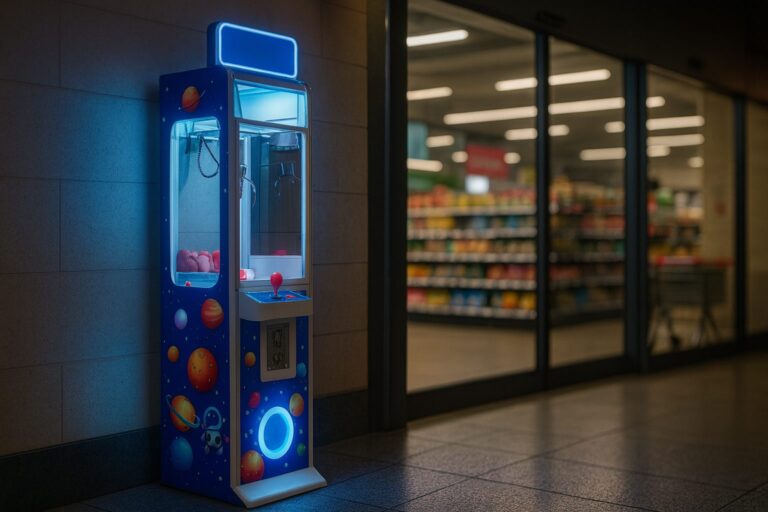
Micro-Placement: Exact Spots Inside a Venue That Print Money
Once you’ve decided which type of venue to target, the next step is deciding where exactly inside that venue to place the machines.
Experienced operators consistently highlight these keywords:
Must-pass areas, waiting time, visibility, and safety/space.
Small placement details can create huge differences in performance between machines in the same venue.
1. Entrances vs. exits vs. inside traffic loops
Different spots create different encounters between people and machines:
Entrances: for first-impression attraction
When people first walk in, their attention is scattered but they’re curious about new things.
This is ideal for machines with:
Strong visual impact
Bright lights
Bold colors
Larger, eye-catching prizes
You can match them with promo signs such as:
“New machines now online—first catch half-price”
Exits: for the “one last try” moment
People are about to leave and may still have spare change or small remaining balances.
Placing a machine here encourages “let’s try one last time before we go,” especially at:
Supermarket exits
Amusement park exits
Cinema exits
It taps into the psychology of “taking home a little gift.”
Central spots along main internal routes
Examples:
The central atrium of a mall floor
Main corridor intersections
Near escalators and elevators
People keep passing through these spots repeatedly. The same person may see your machine several times in one visit, increasing the chance they’ll eventually stop to play.
In short:
Entrance: Grab attention
Exit: Grab the last transaction
Main route midpoints: Provide repeated reminders
2. Near queues: ticket counters, cashiers, restrooms
Many top-performing locations share this common feature: people are forced to stand and wait nearby.
Look for spots like:
Near cinema ticket counters, ticket machines, self-service ordering kiosks
Next to cashiers and payment queues
Waiting areas outside restrooms or near information/service desks
When people are stuck in line, they scroll their phones, then let their eyes wander. If they notice a bright, attractive claw machine beside them, they’re very likely to play a round or two.
These locations also have predictable waiting time: when queues form, your machine naturally becomes a boredom-killer.
3. Visibility rules: “See it from 5–10 meters away”
Operators often find that simply moving a machine a bit further out or removing an obstacle in front of it can significantly increase revenue.
Remember three simple rules:
Don’t let pillars or shelves block the view
People should be able to see the general shape and lighting of your machine from 5–10 meters away.
Avoid tucking machines behind corners or into dead spots. Even if those spots are cheaper, be cautious.
Face the main flow of traffic
The front of the machine should ideally face the main direction of traffic, not just show a side.
Passersby should clearly see the prizes and players’ movements—that’s what triggers the “I want to try too” feeling.
Contrast with surroundings
If the environment is dim, you can slightly increase machine lighting.
If the background is visually busy, use a cleaner, more unified color scheme for your machine and prizes so it stands out as “the claw machine” at a glance.
Put yourself in the shoes of a first-time visitor:
Stand at a distance and look at the machine.
“Would I feel like walking over?”
If not, the placement probably isn’t good enough.
4. Noise & space considerations
Besides looking good, your machines must avoid causing trouble and be easy to maintain:
Don’t block main corridors or emergency exits
This is especially critical in venues like malls, subways, and stations. Local fire safety codes will be strict about emergency corridors and door clearances.
Ideally, leave at least around 1 meter of space around the machines so multiple people can stand and watch or play comfortably.
Control noise levels
Most claw machines allow you to adjust music and voice-prompt volume. Some venue owners are very sensitive about noise.
Near quiet venues—high-end restaurants, bookstores, cafés, clinics—communicate in advance about volume and operating hours to avoid being asked later to turn off or remove the machines.
Make restocking & repairs easy
Avoid squeezing machines into places where it’s hard to open the rear or side panels.
Leave enough space for you to:
Push a cart
Move boxes
Turn off the machine briefly for maintenance
This reduces your time cost per visit.
Once you’ve chosen a venue, try standing there during peak hours for 10–15 minutes to observe:
Foot traffic
Sight lines
Where people naturally stop
Then decide the final placement.
Often, just moving the machine one meter forward or changing its facing angle is enough to turn it from “invisible” to “everyone walks by and sees it.”
How to Test a New Location Before Committing Long-Term
Many operators sign 1–2 year contracts right away, only to find that the machine is “collecting dust.” They want to pull it out but can’t.
A smarter approach is to treat every new location as a test field: run a 7–14 day trial, then decide if you want a long-term deal.
1. The 7–14 Day Trial Strategy
A simple process:
1) Clearly position it as a “trial placement”
Tell the venue owner up front:
You’ll test for 1–2 weeks; you handle machines and maintenance, they provide space and power.
During the trial, you can offer:
Free placement, or
A small symbolic revenue share
to make them more willing to cooperate.
2) Start with just 1–2 machines
The goal is to test traffic and play behavior, not to fill the area with machines from day one.
3) During the trial, don’t obsess over fine-tuning difficulty
Keep the claw strength and settings at a medium, player-friendly level. Let people see that “someone is winning” so you can observe real demand.
2. What numbers should you watch during the trial?
You don’t need a complicated system—just prepare a simple sheet and record the following each day:
1) Number of plays per day
Total plays per day is the most direct indicator.
As a rough guideline:
Dozens to over a hundred plays per day per machine → good potential
Only single-digit plays per day → big warning sign
2) Conversion rate (rough estimate)
During peak hours, stand nearby and observe for 10–15 minutes:
About how many people walk past?
How many slow down or stop and look?
How many actually scan or insert coins and play?
You don’t need precise statistics—this is just to see whether the problem lies in:
Traffic itself, or
The placement / machine / prizes
3) Average revenue per play & gross margin
Very simple:
Daily revenue = price per play × number of plays that day
Subtract an estimated prize cost (for example, 30–40% of revenue), and you’ll have a rough gross margin.
Compare this with your own target—e.g., how much gross profit per month per machine you need—to see whether the location has room to grow.
These numbers help you answer:
“Is this location worth a long-term deal? Is it better as a secondary route point? Or should I simply walk away?”
3. When to walk away: red flag signals
After the trial period, if you see these patterns, be cautious. It may be better to remove the machine than to force it:
1) Very low plays for 7–14 consecutive days
If plays remain in single digits even during evenings and weekends, and:
You’ve already tried adjusting lighting, orientation, and prizes
But results don’t improve
then the issue is likely structural: the traffic or venue type simply isn’t a good fit.
2) Plenty of foot traffic, but almost no one stops to play
This means:
People are in a hurry, or
Their mindset in this environment doesn’t match the “let’s play” behavior
In that case, the machine becomes pure “background decoration” and won’t earn much.
3) Poor cooperation from the venue
For example:
They constantly pile goods, banners, or temporary booths around your machines
Customers cannot easily get close to play
They suddenly move your machines, cut power, or frequently ask you to shut down
All of these are negative signals for long-term operations.
4) Your own maintenance cost is far higher than expected
If each restocking or repair visit requires a long trip, and the time + travel costs eat into most of your profit, the location may not be worth keeping.
Remember:
Good locations feel “easier over time.”
Bad locations feel “more exhausting the longer you stay.”
By using a 7–14 day trial, you can filter out locations that “look good but perform badly” with minimal cost, and save your money and energy for the truly promising ones.
Negotiating Rent & Revenue Share with Location Owners
Many people say “location X is super profitable,” but when they actually sit down to discuss rent, revenue share, and contract terms, they feel very weak.
This section aims to help you:
Know the common deal structures
Have your own numbers and bottom lines
Understand key contract points
So you can negotiate with confidence.
1. Common deal structures
In reality, claw-machine operators and venue owners typically work under a few basic models:
1) Flat monthly rent
You pay a fixed fee to the venue each month (in USD or RMB).
Pros: All revenue above that is yours; the better the machines perform, the more you earn.
Cons: If revenue is unstable, you carry all the risk.
Many guides call this location rent, common in malls and arcades, usually taking up a certain fraction of monthly machine revenue.
2) Pure revenue share
No fixed rent. Instead, you share a percentage of gross revenue, for example:
You: 70%
Venue: 30%
Industry info often cites 10–40% or even 20–50% revenue share ranges, depending on traffic and location value.
Similar to vending machines: many operators share around 5–25% with venue owners.
3) “Minimum guarantee + revenue share” hybrid
You pay a modest base rent to give the venue a sense of security, then apply a revenue share on top.
This is common in high-traffic, high-value locations such as top malls, cinemas, or tourist attractions where the landlord has a lot of leverage.
4) Operator provides all machines; venue only takes a share
In some markets, entertainment companies offer venues a “zero equipment cost + revenue share” model: the company provides the machines; the venue provides space and power.
If you operate as a route operator and negotiate with venues yourself, you can use a similar pitch: you handle machines and maintenance; they turn unused space into passive income.
Simple suggestion:
For average locations: prioritize pure revenue share or low base rent + share to lower your risk.
For prime, golden locations: you can accept a higher share to the venue, as long as your own numbers still work.
2. What to prepare before negotiations
The better prepared you are, the easier it is to reach a good deal.
1) A simple revenue example
Use the earlier formula plus public industry data to create a sample:
For instance:
A single machine in a mid-traffic location might generate 200–500 USD per week
In high-traffic spots, monthly revenue can be in the thousands of USD
Make a simple table showing:
Expected monthly revenue
Estimated prize cost
Maintenance cost
The share you can offer to the venue
This helps them see it’s a win-win business, not just you “taking up space.”
2) The extra value you bring
Besides revenue sharing, emphasize that machines can:
Make customers stay longer and feel less bored while waiting
Encourage people who catch prizes to post photos on social media, giving the venue free exposure
Support joint promotions across multiple locations if you have a route (e.g., “collect stamps at multiple stores for free claw plays”)
3) The work you’ll handle
Clearly state who is responsible for:
Machine maintenance and repairs
Restocking and cleaning
Handling electricity costs and related issues
In most cases, you as the operator take care of all machine-related work; the venue just provides space and basic cooperation.
When you show up with:
A clear revenue example
Extra value beyond money
A clear division of responsibilities
the venue sees you as a serious partner—not someone gambling on luck.
3. Key contract terms to check
What truly decides whether you’ll make money long-term is in the contract details. At minimum, watch these:
1) Contract duration & renewal terms
For first-time cooperation, aim for 6–12 months so you can adjust based on real data.
Clarify:
How renewal works
Whether you get priority renewal if your machines perform well
2) Exclusivity / competition clauses
Some malls may offer you “exclusive rights for claw machines” in a certain area; others might allow multiple operators.
If you can secure exclusive rights for a floor or area, it may be worth accepting slightly higher revenue share.
3) Rights and process for removing / moving machines
Specify:
Under what conditions you can remove machines early
(e.g., several months of poor performance, serious breach by the venue)Under what conditions the venue can ask you to move or remove machines
How much notice (in days) they must give you
This prevents the venue from arbitrarily kicking you out without warning.
4) Electricity, maintenance responsibilities & safety
Electricity costs for claw machines are generally low (often only a few to several USD per month), but you should still clearly state who pays for it.
Also address:
Damage caused by decoration work or moves
Theft or vandalism
Responsibility for repairs
Put these into the contract to avoid “who pays for what” arguments later.
5) Settlement method and schedule
Clarify:
Settlement frequency (weekly, monthly, or after revenue hits a certain amount)
Payment methods (cash, transfer, etc.)
If using QR code payments:
How backend data is shared
How both parties can verify numbers
If you understand:
Common revenue share ranges
Your own basic numbers
Key contract terms
you’ll already be much more professional than many people who jump into claw machines on impulse.
Example Location Scenarios (Mini Case Studies)
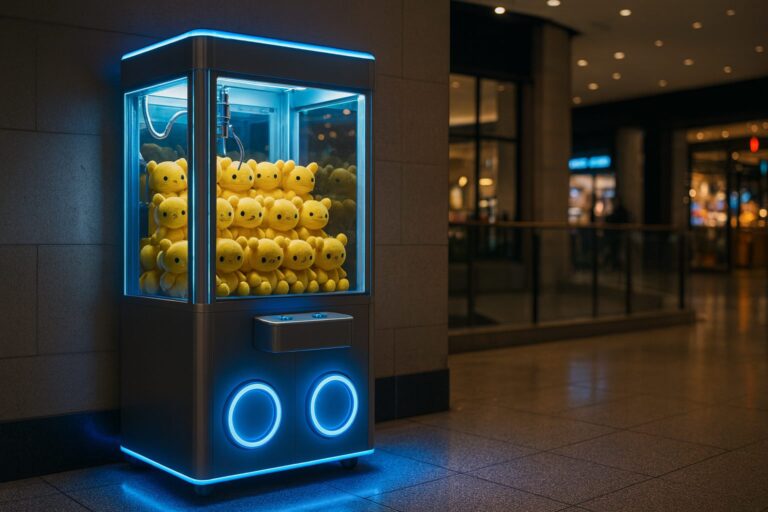
The following three mini cases are based on public industry data + real operator examples in different regions.
The numbers do not guarantee you will earn this much, but they can help you build a rough sense of the order of magnitude.
Case 1: Same Machine – Downtown Shopping District vs. Large Supermarket
Basic Situation
Machine: 1 standard plush claw machine, price per play: 1 USD (or equivalent).
Downtown shopping district:
Located on a busy commercial floor.
Daily visitors on that floor: 8,000–10,000 people, traffic is fairly concentrated.
The machine is placed at the entrance to the food court and near the cinema.
Revenue share to venue: 30% of gross revenue (typical range).
Large supermarket:
Daily visitors: 4,000–5,000 people.
The machine is placed near the exit and checkout area.
Same revenue share: 30%.
For easy comparison, we’ll use a 30-day month.
Simulated Monthly Data
Downtown shopping district
Average 160 plays per day → 4,800 plays per month
Gross revenue: 4,800 × 1 = 4,800
Prize + consumables cost (40% of revenue): 1,920
Venue share (30% of revenue): 1,440
Approximate net profit: 4,800 − 1,920 − 1,440 = ≈ 1,440
Large supermarket
Average 90 plays per day → 2,700 plays per month
Gross revenue: 2,700 × 1 = 2,700
Prize + consumables cost (40%): 1,080
Venue share (30%): 810
Approximate net profit: 2,700 − 1,080 − 810 = ≈ 810
ROI Analysis & Takeaways
If the total investment in this machine (machine + shipping + initial prizes) is 3,000:
Downtown shopping district: a little over 2 months of profit can recoup the cost.
Large supermarket: about 4 months to recoup the cost.
Key lessons:
Foot traffic + time spent in the area determine the revenue ceiling.
At the same revenue-share level, downtown locations look more expensive but can pay back faster.
Supermarkets are better suited as “route points” with stable performance, not necessarily your only main profit center.
Case 2: Competing for Passersby – A 10-Machine Mini Claw Store Near a Subway Station
Location: A small shop right next to a subway station entrance, with surrounding office buildings and a shopping mall. Foot traffic is heavy and flows up and down throughout the day.
Business model:
Rent one small shop.
Place 10 different mini claw machines inside; the shop is mainly filled with machines, with simple decoration.
Industry reference:
In high-traffic locations, average daily revenue per machine is often around 35–70 USD.
Monthly revenue per machine can reach 800–1,500 USD or more in some areas.
Simulated Monthly Data
Assume the 10 machines all perform at a mid-range level:
Per-machine daily revenue: 50
Per-machine monthly revenue: 50 × 30 ≈ 1,500
Total monthly revenue for 10 machines: 15,000
Cost structure
Prize + consumables cost (40% of revenue): 6,000
Shop rent + property management + utilities: 2,500
Labor + travel and miscellaneous: 1,000–1,500, assume 1,200
Approximate net profit
15,000 − 6,000 − 2,500 − 1,200 = ≈ 5,300
If total investment for this small shop (10 machines + decoration + deposits, etc.) is 40,000–45,000:
With ~5,000 net profit per month, 8–9 months of operation can basically recover the investment, which is similar to many publicly shared cases that mention 9–14 months.
ROI Analysis & Takeaways
At this scale, foot traffic + a cluster of machines can smooth out differences in single-machine performance, giving more stable total revenue.
However, risk is also concentrated:
If the area is renovated, rent increases sharply, or foot traffic drops, your pressure will be significant.
A safer strategy is to:
Use 2–3 machines to test the location first.
Confirm that performance is stable before expanding to 10+ machines.
Case 3: “Add-On Income” Claw Machine in a Milk Tea Shop
Basic Situation
Location: A milk tea shop with decent foot traffic, near schools and residential blocks.
Cooperation model:
You provide the machine and prizes.
The milk tea shop provides space and electricity.
Revenue share: 30% of gross revenue to the shop (their “commission”).
Machine: 1 mini claw machine, price per play: 0.5 USD (or equivalent local currency).
Simulated Monthly Data
This type of shop has relatively stable but not huge traffic. Based on operator sharing, daily revenue typically ranges from hundreds of RMB up to just over 1,000 RMB in better locations.
For the simulation, we’ll choose a moderate level:
Average 70 plays per day → 2,100 plays per month
Gross revenue: 2,100 × 0.5 = 1,050
Prize + consumables cost (40%): 420
Shop’s share (30%): 315
Approximate net profit: 1,050 − 420 − 315 = ≈ 315
If the total investment in this mini machine is 1,500:
Monthly net profit is a little over 300,
Payback period is roughly 5 months.
After payback, aside from small ongoing maintenance costs, most revenue is profit.
Basic Situation
ROI Analysis & Takeaways
For you (the operator):
This type of location is easy to manage and maintain.
You can schedule restocking together with visits to nearby locations to save time.
You can run joint promotions, such as:
“Buy a drink and get a free claw-machine play,”
Using prize coupons to drive more drink sales.
For the milk tea shop:
The machine provides additional entertainment:
It keeps customers occupied while waiting for drinks.
Visible winning moments and photo posts on social media can attract more walk-in customers.
Combined with the shop’s regular business, this becomes a low-risk extra income source.
If you operate several such machines across different shops and commercial areas, the combined income forms a meaningful, relatively stable cash flow, and the risk of any single location underperforming is reduced.
What You Can Learn from These Three Cases
From these three examples, you can clearly see:
Even with the same type of claw machine, the payback period and net profit can differ greatly depending on the location.
Prime, high-traffic locations (downtown malls, subway-adjacent shops) have high ceilings and can pay back quickly, but:
Negotiations are harder,
Costs and risks are higher.
Small “add-on income” locations (like milk tea shops) may not make huge profits individually, but:
They’re stable,
Easy to maintain,
Very suitable for spreading machines across many points.
A sensible overall approach is:
Use the 3F framework (Flow, Fit, Finance) to evaluate locations.
Start with small-scale tests.
Only expand and double down on locations that pass your trial-run data test and fit your time, budget, and risk tolerance.
FAQ
1. Is owning a claw machine worth it? / Is a claw machine business worth it? / Are claw machines a good business?
It can be very worthwhile when the location is good and costs are under control. In the examples above, a single well-placed machine can generate a few hundred to a few thousand USD in monthly net profit, and many operators recover their machine and upfront investment in about 3–6 months. In weak locations, the payback period can stretch beyond a year, so location choice is the real “make or break” factor.
2. How much does a claw machine make on average?
It can be very worthwhile when the location is good and costs are under control. In the examples above, a single well-placed machine can generate a few hundred to a few thousand USD in monthly net profit, and many operators recover their machine and upfront investment in about 3–6 months. In weak locations, the payback period can stretch beyond a year, so location choice is the real “make or break” factor.
3. How much to open a claw machine?
The upfront budget for one machine usually includes:
Machine purchase
Shipping and installation
Initial batch of prizes
Any simple decoration or electrical work
Deposits or pre-paid rent
In the examples given, this total investment is roughly 1,500–3,000 USD per machine, depending on size and setup. This is the amount used when calculating the payback period.
4. How much does it cost to start a claw machine arcade?
For a small arcade-style shop built mainly around claw machines (for example, 10 machines in a mini store near a subway station), the total initial investment is around 40,000–45,000 USD including machines, decoration and deposits. With about 15,000 USD in monthly revenue and roughly 5,300 USD in monthly net profit, the payback period in that scenario is around 8–9 months.
6. Where is the best place to put a claw machine? / Where to place a claw machine? / Where can I place my claw machine?
The most profitable placements combine strong traffic, the right audience and room to play. Priority venue types are:
Tier 1: shopping malls, cinemas, FECs, indoor amusement centers, entertainment complexes
Tier 2: large supermarkets, restaurants, cafés, convenience stores, gas stations
Tier 3: transit hubs, campuses, hotels, hospitals, clinics and other niche venues
Inside each venue, the best spots are must-pass areas with waiting time and high visibility, such as food courts, cinema entrances/exits, kids’ zones, checkout lines, ticket counters, and near escalators or elevators—while avoiding cramped corners, areas next to toilets or trash cans, and places that block main walkways.
7. How to find a location for a claw machine?
Use the 3F framework:
Flow (traffic): look for places where several hundred to a few thousand people pass by daily, and where people actually have time to stop (queues, waiting areas, people waiting for food or movies).
Fit (match): focus on venues with families, couples, students and playful adults, plus a relaxed environment that supports impulse spending.
Finance (profitability): estimate daily revenue using foot-traffic and conversion assumptions, subtract prize cost, rent/revenue share and maintenance, then check whether the projected monthly net profit gives an acceptable payback period.
Start with a 7–14 day trial using 1–2 machines in each promising venue, track plays per day and rough conversion, and only sign long-term deals where the numbers look healthy.
8. How much do claw machine stores make?
A compact, 10-machine claw shop in a high-traffic area can reach about 15,000 USD in monthly revenue. After typical costs—roughly 6,000 USD for prizes, 2,500 USD for rent and utilities, and around 1,200 USD for labor and travel—that leaves about 5,300 USD in net profit per month. Actual performance depends on location quality and management, but this illustrates the income potential of a small arcade built around well-placed machines.
9. What are good things to put in a claw machine?
Prize choices should match the customer profile and venue type:
Malls & cinemas: cartoon plushies, blind boxes, small electronics, anime/movie IP characters, themed sets that encourage “collect them all” and photo sharing
Supermarkets: parent-child toys, small stationery, kid-friendly mini toys, affordable IP plushies
Restaurants & cafés: small plushies, keychains, plus drink or snack vouchers and coupons
Transit hubs & gas stations: travel accessories (sleep masks, neck pillows, luggage tags), in-car accessories and light, portable plush toys
Aligning prizes with local customers increases both play volume and perceived value.
10. How much electricity does a claw machine use?
Electricity usage for claw machines is relatively low compared with other costs. Typical power expense is only a few to several USD per month per machine, so prize cost, rent/revenue share and maintenance have a much larger impact on profit. Even so, contracts should clearly state who pays for electricity, along with responsibilities for damage, theft and repairs.



 English
  Español
  العربية
  Français